

PRP Therapy at PHI is performed by board-certified physicians Dr. Faisal Lalani and Dr. Nadiv Samimi at our Beverly Hills practice under image guidance. A concentrate of your own platelets, PRP delivers growth factors that support healing in joint osteoarthritis, tendon and ligament injuries, and post-surgical recovery. It is the most established autologous regenerative protocol.
What PRP Is
Platelet-rich plasma is a concentrate prepared from your own blood. Platelets are the components responsible for clotting and tissue repair, and they contain dense concentrations of growth factors that signal damaged tissue to heal.
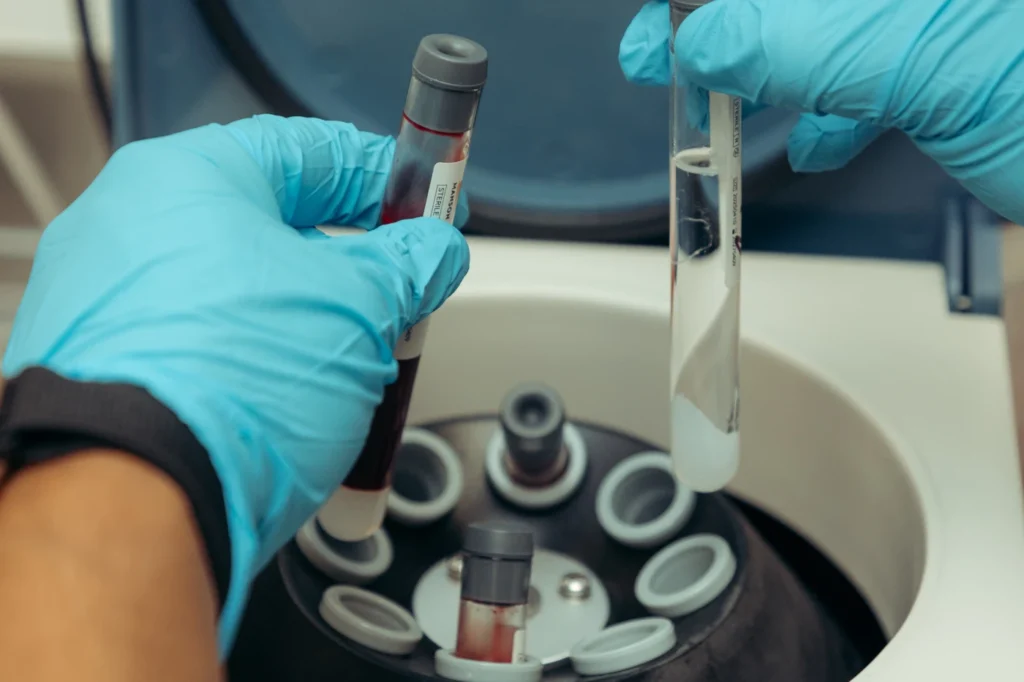
To prepare PRP, a small amount of your blood is drawn and processed in a centrifuge to separate the platelets from other blood components. The resulting concentrate contains 4 to 7 times the platelet density of normal blood, which means a much higher concentration of healing growth factors.
This concentrate is then injected directly into the injured or arthritic area. Because PRP is derived from your own blood, the rejection and disease transmission risks associated with foreign biologics are not a concern.
An Overview on PRP
How PRP Therapy Works
The process is performed in a single visit. A small blood sample is drawn, processed in our centrifuge for approximately 15 minutes, and the resulting PRP is injected into the target tissue under image guidance.
Different conditions require different PRP formulations and injection techniques. For joint osteoarthritis, PRP is typically injected directly into the joint capsule. For tendon injuries, PRP is injected into and around the affected tendon, often using ultrasound guidance to confirm precise placement.
The injection itself takes about 15 minutes. PHI offers a range of comfort options, from local anesthetic to sedation, and the total visit time is typically 60 to 90 minutes from start to finish.
Concerns We Treat with PRP Therapy
Joint conditions
- Knee osteoarthritis (early to moderate)
- Hip osteoarthritis
- Shoulder arthritis
- Ankle and foot arthritis
- Other joint conditions where regenerative support is appropriate
Tendon and ligament conditions
- Rotator cuff tendinopathy and partial tears
- Tennis elbow (lateral epicondylitis) and golfer’s elbow (medial epicondylitis)
- Patellar tendinopathy (jumper’s knee)
- Achilles tendinopathy
- Plantar fasciitis
- Ligament injuries and sprains
Other conditions
- Post-surgical recovery, in coordination with the surgical team
- Persistent pain following injury where regenerative support is appropriate
- Specific cases of degenerative disc disease
What the Evidence Shows
PRP has the strongest evidence base of any autologous regenerative protocol for orthopedic conditions. Multiple high-quality systematic reviews and meta-analyses of randomized controlled trials have demonstrated significant pain relief and functional improvement for knee osteoarthritis at 6 and 12 months after injection.
Systematic reviews comparing PRP to hyaluronic acid for knee osteoarthritis have found PRP demonstrated superior outcomes at both 6 and 12 months on standardized pain and function scores.
For tendon injuries specifically, PRP has accumulating evidence supporting its use, particularly for chronic conditions where conservative treatment has not produced adequate response. Outcomes vary by specific tendon and clinical situation; your physician will discuss what the evidence supports for your particular condition. This is a meaningfully different evidence base than newer regenerative approaches: PRP is established, well studied, and supported by extensive clinical research.
Why Patients Choose PHI for PRP Therapy
Image-guided injection every time
PRP delivery requires precise placement to be effective. Joint PRP must reach the joint capsule; tendon PRP must reach a small target. PHI uses ultrasound or fluoroscopic guidance for every PRP injection.
Two board-certified physicians
Dr. Faisal Lalani and Dr. Nadiv Samimi, both trained in interventional pain at Cedars-Sinai, where Dr. Lalani’s training includes a specific emphasis on ultrasound-guided regenerative procedures.
Standardized PRP preparation
PRP outcomes depend on the preparation protocol. Different centrifuge systems produce PRP with different platelet concentrations and biological activity. PHI uses standardized protocols to ensure consistent quality.
Honest evaluation of fit
PRP is excellent for some conditions and limited for others. PHI evaluates whether PRP is the right protocol for your situation rather than offering it as a default for every patient.
Comprehensive regenerative menu
PHI offers PRP alongside A2M, stem cell therapy, and other regenerative protocols. If PRP is not the best fit, your physician will tell you so and recommend the appropriate alternative.
Concierge, coordinated care
Single-physician continuity from consultation through treatment and return to activity. Patients receive clear guidance and transparent pricing at consultation.
What to Expect
Preparation
Your physician confirms candidacy through review of imaging, exam, and treatment history. Some medications, including certain anti-inflammatories (NSAIDs), should be paused for 1 to 2 weeks before PRP because they can interfere with the platelet response. You will receive specific instructions.
The procedure
A small blood sample is drawn and processed in a centrifuge for about 15 minutes. Once the PRP is prepared, the injection itself takes about 15 minutes. PHI offers comfort options from local anesthetic to sedation.
Recovery
Activity restrictions vary by indication. For joint PRP, most patients resume normal activity within 24 to 48 hours, with continued caution about high-impact activity for 1 to 2 weeks. For tendon PRP, more specific restrictions apply, often including a structured rehabilitation protocol.
Healing begins
PRP does not produce immediate relief. The healing process develops gradually over several weeks. Some patients experience increased pain in the first week as the inflammatory healing response begins; this is expected.
Full benefit
Maximum benefit typically develops by 12 weeks. Some conditions, particularly chronic tendon issues, may continue to improve for several months after the injection.
Frequently Asked Questions
PRP uses your own blood, processed and reinjected, which falls under FDA regulations for autologous biologics. The procedure is regulated but does not require specific FDA drug approval for individual conditions because PRP is derived from your own blood.
PRP does not produce immediate relief. Healing develops gradually. Most patients begin to notice improvement at 4 to 6 weeks, with maximum benefit typically at 12 weeks. Some conditions continue to improve for months.
Duration varies by condition. For joint osteoarthritis, relief typically lasts 6 to 12 months from a single treatment, with some patients experiencing longer benefit. For tendon injuries that respond well, the relief is often more durable because the underlying tissue has healed rather than just the symptoms being suppressed.
Many patients receive a single injection. For osteoarthritis, some protocols use a series of 2 to 3 injections spaced 2 to 4 weeks apart. Your physician will recommend the protocol that fits your specific condition.
Cortisone reduces inflammation and provides faster but typically shorter relief, often with cumulative effects from repeat injections. PRP supports tissue healing through a different mechanism, with slower onset but potentially more durable benefit and no cumulative tissue effects.
PRP delivers growth factors derived from your platelets. Stem cell therapy delivers cells that themselves can support repair. PRP is generally appropriate for early-to-moderate conditions and milder tissue damage; stem cell therapy is generally appropriate for more advanced cartilage damage or conditions where PRP has been tried without sufficient response.
Because PRP uses your own blood, immune rejection and disease transmission risks are not a concern. Standard procedural risks include temporary pain or swelling at the injection site, bleeding, and rare infection. Many patients experience increased pain in the first week, which is expected.
For some patients with early-to-moderate conditions, PRP can delay or avoid surgery. For more advanced conditions, surgery may eventually be necessary. Your physician will give you an honest assessment of your specific situation.
NSAIDs (anti-inflammatory medications like ibuprofen and naproxen) can interfere with the platelet response that drives PRP’s healing effect. Most protocols recommend pausing NSAIDs for 1 to 2 weeks before and after the procedure. Your physician will provide specific guidance.
Insurance coverage and payment options may vary. We provide documentation for you to seek reimbursement through your out-of-network benefits, which may apply to certain services. All pricing is disclosed at consultation.
Pricing varies by the joint or tendon being treated. All costs are disclosed at consultation, with no surprise billing.
Yes. PHI regularly treats patients from outside Los Angeles, including Las Vegas, Palm Springs, London, and other international locations.