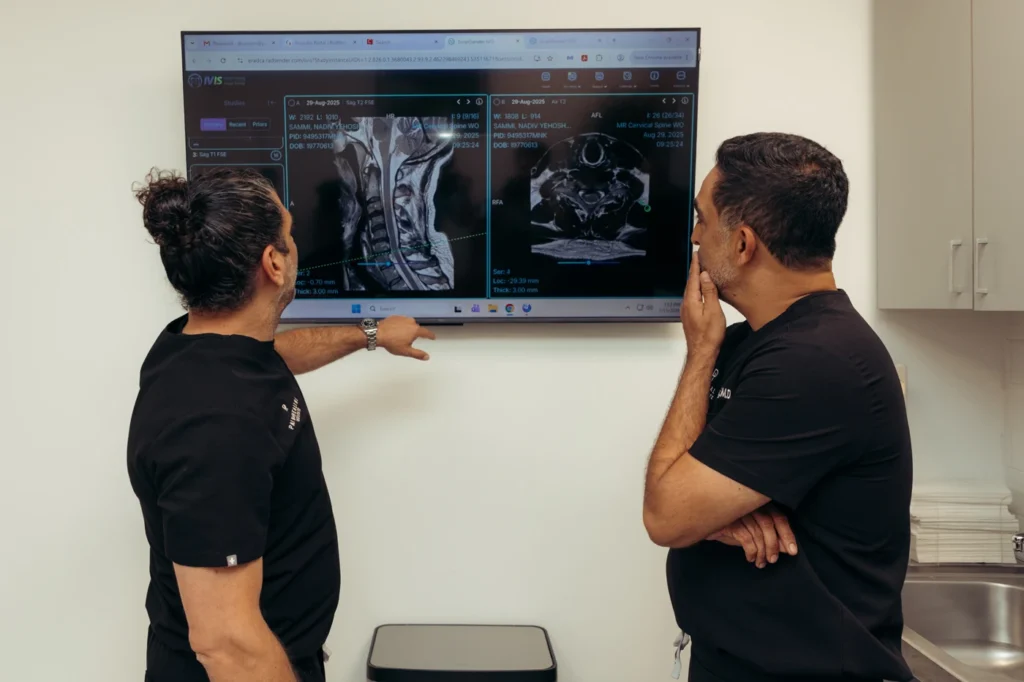


Facet joint injections at PHI are performed by board-certified physicians Dr. Faisal Lalani and Dr. Nadiv Samimi in our affiliated surgical suite at 455 N Roxbury Drive, Suite B, Beverly Hills. Used to diagnose and treat spinal pain from the facet joints, they treat the cervical, thoracic, and lumbar regions under fluoroscopic guidance.
What Facet Joint Injections Do
Your spine has small paired joints called facet joints connecting each vertebra to the one above and below it. These joints control how your spine bends and twists. Like any other joint in your body, they can develop arthritis, become inflamed after injury, or generate pain from wear over time.
Facet joint pain is often missed because the symptoms are non-specific. The pain is usually felt in the spine itself rather than radiating down an arm or leg. Many patients receive treatment for a herniated disc or general back pain for years before facet involvement is identified.
A facet joint injection delivers a combination of corticosteroid and local anesthetic directly into the joint. This serves two purposes at once. Diagnostic: if your pain improves significantly after the injection, the facet joint is confirmed as a primary source of your symptoms, which guides what comes next. Therapeutic: the corticosteroid reduces inflammation in the joint, which often produces pain relief lasting several months.
For patients whose facet injection confirms the diagnosis but whose relief is shorter than desired, radiofrequency ablation is typically the next step. RFA targets the small nerves carrying pain signals from the facet joint and produces relief lasting 6 to 18 months.
How the Procedure Works
The injection is performed in our affiliated surgical suite under fluoroscopic guidance. The physician uses real-time imaging to confirm precise needle placement before delivering medication. Facet joints are small targets requiring imaging precision; injections without guidance are less accurate.
You arrive, are positioned comfortably, and the injection site is cleaned and numbed with a local anesthetic. The physician advances a thin needle into the joint capsule, confirms position with imaging, and delivers the medication. The procedure typically takes about 20 minutes, depending on how many joints are treated.
PHI offers a range of comfort options, from local anesthetic to nitrous oxide, conscious sedation (Versed), or deep sedation (Propofol). You leave the same day; patients who receive sedation arrange transportation home.
Three Regions We Treat
Cervical Facet Injections
Cervical facet joints are the small joints in the neck. Pain from these joints is usually felt in the neck itself and may extend into the upper shoulder or base of the skull. It does not typically radiate down the arm.
Thoracic Facet Injections
Thoracic facet joints are in the middle of the spine, behind the rib cage. Thoracic facet pain is less common than cervical or lumbar but is a real source of mid-back pain that often goes undiagnosed.
Lumbar Facet Injections
Lumbar facet joints are in the lower back. Lumbar facet pain is one of the most common causes of low back pain, particularly in patients over 50, but it is frequently misdiagnosed as general degenerative disc disease or muscle strain.
When Facet Joint Injections Are the Right Option
Facet injections fit when
- Your pain is localized in your spine rather than radiating down an arm or leg
- Your pain worsens with bending backward, twisting, or standing for long periods
- Your pain is often better when sitting or leaning forward
- Imaging shows facet arthritis or facet joint changes that match your symptom pattern
- Conservative treatments have not provided adequate relief
Not the right starting option when
- Your pain primarily radiates down an arm or leg (an epidural steroid injection often fits better)
- Your symptom pattern suggests nerve compression rather than joint involvement
- You have a contraindication to corticosteroids
Your physician will tell you which fits during consultation. The diagnostic value of a facet injection is part of why it is recommended: even if the relief is short, the information it provides is often what unlocks the right longer-term treatment.
Why Patients Choose PHI for Facet Joint Injections
Convenient surgery center
PHI performs every injection in our affiliated surgery center at 455 N Roxbury Drive, Suite B, not a standard office procedure room.
Image-guided every time
Every facet injection is performed under fluoroscopic guidance. Image guidance is standard at PHI, not optional.
Two board-certified physicians
Dr. Faisal Lalani and Dr. Nadiv Samimi, both trained in interventional pain at Cedars-Sinai. You meet your physician at consultation and the same physician performs your procedure.
Diagnostic-to-therapeutic continuity
PHI tracks your response, evaluates whether radiofrequency ablation fits as a next step, and performs it in the same facility with the same physician.
Concierge model
Single-physician continuity from consultation through your treatment series, with direct access. International patients receive coordinated travel and scheduling.
Concierge, coordinated care
Single-physician continuity from consultation through treatment and return to activity. Patients receive clear guidance and transparent pricing at consultation.
What to Expect: Before, During, and After
Consultation and prep
Your physician reviews your imaging, history, and current medications at consultation. Some medications, including certain blood thinners, must be paused before the procedure; you will receive specific instructions.
The injection
The injection itself typically takes about 20 minutes, depending on how many joints are treated. PHI offers a range of comfort options, from local anesthetic to nitrous oxide, conscious sedation (Versed), or deep sedation (Propofol). Most patients describe the procedure as briefly uncomfortable rather than painful.
Recovery
You rest in our recovery area for about 20 to 30 minutes. Patients who receive sedation arrange transportation home. Activity restrictions for the rest of the day are minimal.
The diagnostic window
The local anesthetic often produces immediate relief, the diagnostic window your physician will ask you to track. The corticosteroid then takes effect: most patients begin to feel relief within several days, though it can take up to 7 to 10 days.
Lasting relief
Most patients experience relief lasting weeks to several months. Patients who respond well but find the relief shorter than desired are typically candidates for radiofrequency ablation, which targets the nerves that transmit facet joint pain for longer-lasting relief.
Frequently Asked Questions
Both evaluate facet joint pain. A facet injection delivers medication directly into the joint; a medial branch block targets the small nerves carrying pain signals from it. PHI uses both, choosing the approach that fits your diagnosis and whether radiofrequency ablation is being considered as a next step.
Duration varies. Some patients experience months of relief from a single injection; others experience shorter relief that confirms the diagnosis and suggests RFA as the next step. The duration of your response is itself useful information for your physician.
It depends on the option you choose. PHI offers local anesthetic, nitrous oxide, conscious sedation (Versed), and deep sedation (Propofol). Your physician helps you choose the right level of comfort for your procedure.
Most patients describe the procedure as briefly uncomfortable rather than painful. The local anesthetic numbs the skin and tissue along the needle path.
If you choose local anesthetic only, most patients drive themselves home. If you receive sedation, arrange transportation, as you should not drive the same day.
Facet joint injections are well-established procedures with a strong safety profile when performed under image guidance. Risks include temporary increase in pain, bleeding or infection at the injection site, and very rare complications related to needle placement. Image guidance significantly reduces these risks. Your physician will review the full risk profile at consultation.
A facet injection treats pain coming from the small joints of the spine. An epidural injection treats nerve pain that radiates from the spine into an arm or leg. They target different sources of pain. Your physician recommends which fits based on your symptom pattern and imaging.
This is one of the most useful outcomes a facet injection can produce. A clear positive response with shorter-than-desired duration confirms the facet joints as the source of your pain and identifies you as a strong candidate for radiofrequency ablation, which provides relief lasting 6 to 18 months on average.
If a properly placed facet injection does not produce meaningful relief, that is diagnostic information. It tells your physician the facet joints are likely not the primary source of your pain. The next step is usually to revisit imaging and consider whether a different treatment approach fits better.
Insurance coverage and payment options may vary. All pricing is disclosed at consultation.
Yes. PHI regularly treats patients from outside Los Angeles, including Las Vegas, Palm Springs, London, and other international locations. For patients traveling specifically for facet evaluation, we coordinate consultation, imaging review, and procedure scheduling within a single visit when possible.