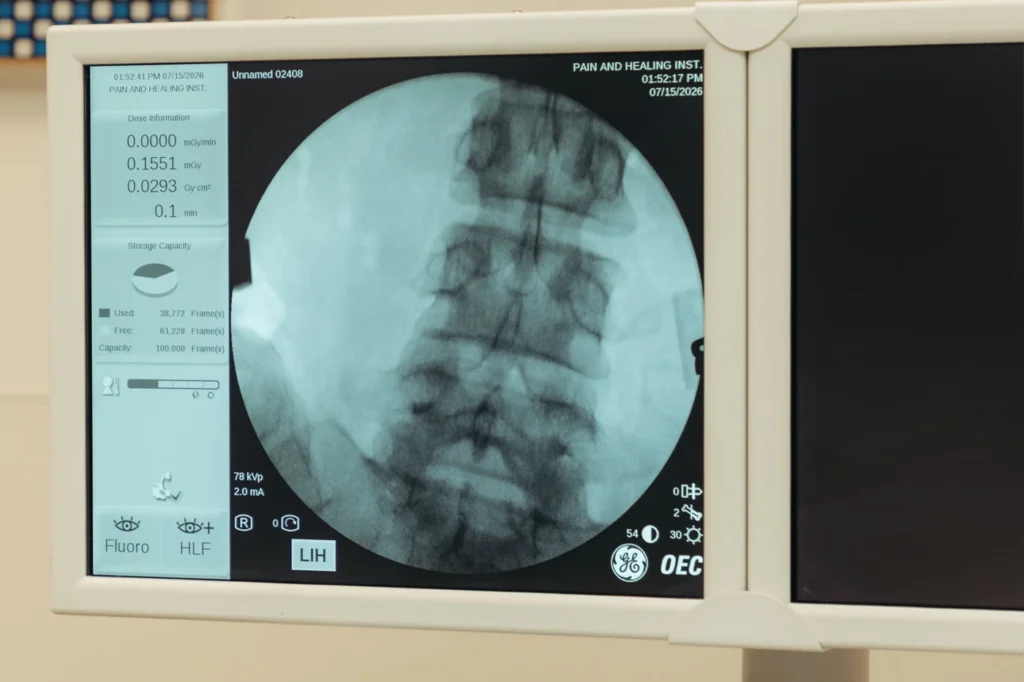


Radiofrequency ablation at PHI is performed by board-certified physicians Dr. Faisal Lalani and Dr. Nadiv Samimi under fluoroscopic guidance in an affiliated surgical suite. RFA interrupts the nerves carrying pain signals from a confirmed joint or region, typically providing 6 to 18 months of relief and repeatable when pain returns.
What Radiofrequency Ablation Does
Radiofrequency ablation (RFA) uses precisely targeted heat energy to interrupt the small nerves that carry pain signals from a specific joint or region. Unlike a steroid injection, which reduces inflammation, RFA disrupts the pain signaling pathway itself.
The interrupted nerves grow back over time, which is why RFA does not produce permanent results. Most patients experience pain relief lasting 6 to 18 months, and the procedure can be repeated when the nerves regenerate and pain returns.
A 2022 systematic review and network meta-analysis of randomized controlled trials confirmed that radiofrequency denervation produces meaningful pain relief for facet joint-derived chronic low back pain in both short-term (within 6 months) and long-term (12 months) follow-up.
This is why RFA is often described as the longer-term destination for patients whose pain has been confirmed as facet-mediated through a successful diagnostic block.
When Radiofrequency Ablation Is the Right Option
RFA is right when
- A prior diagnostic injection (medial branch block, facet joint injection, genicular nerve block, or SI joint injection) confirmed the source of your pain
- The injection produced meaningful relief but didn’t last as long as you wanted
- Your pain pattern fits the joint or nerve target RFA can address
- Conservative treatments and shorter-lasting injections haven’t provided durable relief
Not the right starting option when
- Your pain hasn’t been clearly localized to a specific joint or nerve target
- Imaging suggests pain primarily from nerve compression rather than joint involvement
- You haven’t had a positive response to a diagnostic block
- The pain pattern suggests mechanical instability or another condition RFA won’t address
A positive diagnostic block is the most important predictor of RFA success. When a diagnostic injection produces a strong positive response, PHI can often proceed directly to RFA. For cervical RFA, or when the diagnostic response is less certain, a second confirmatory block may be recommended.
Five Regions We Treat
Cervical RFA
Cervical RFA targets the medial branch nerves of the cervical facet joints in the neck. It is appropriate for patients with confirmed cervical facet syndrome whose pain has not responded adequately to facet injections alone.
Thoracic RFA
Thoracic RFA targets the medial branch nerves of the thoracic facet joints in the mid-back. Thoracic facet pain is less common than cervical or lumbar but is a real source of chronic pain that often goes undiagnosed.
Lumbar RFA
Lumbar RFA is the most common RFA procedure and targets the medial branch nerves of the lumbar facet joints in the low back. Randomized placebo-controlled trials demonstrate that lumbar facet RFA produces statistically significant pain relief in short-term, medium-term, and long-term follow-up compared to placebo.
Sacroiliac RFA
Sacroiliac RFA targets the small nerves carrying pain signals from the sacroiliac joint. SI joint pain is a frequent and frequently missed source of low back and buttock pain.
Genicular RFA
Genicular RFA targets the small nerves carrying pain signals from the knee joint. It is performed primarily for patients with chronic knee pain from osteoarthritis who are not surgical candidates, are recovering from knee replacement with persistent pain, or want to delay knee replacement.
Why Patients Choose PHI for Radiofrequency Ablation
Affiliated surgical suite
Performed in an affiliated surgical suite, every ablation, not a standard office procedure room.
Fluoroscopic guidance
Fluoroscopic guidance on every ablation.
Two board-certified physicians
Two board-certified physicians, both Cedars-Sinai trained.
Diagnostic-to-therapeutic continuity
Diagnostic-to-therapeutic continuity, the same physician throughout.
Thermal and pulsed RFA
Thermal and pulsed RFA matched to your condition.
Concierge model
Concierge model: single-physician continuity, direct access.
Concierge, coordinated care
Single-physician continuity from consultation through treatment and return to activity. Patients receive clear guidance and transparent pricing at consultation.
What to Expect: Before, During, and After
Confirming the fit
Your physician confirms RFA fits your imaging, prior diagnostic block response, and history. Some blood thinners are paused beforehand; you’ll get specific instructions.
The procedure
Most ablations are performed under sedation and take about 60 minutes, depending on the levels treated. Local anesthetic numbs the needle path; pressure and warmth at the sites are expected.
Recovery
Rest in the recovery area about 30 to 60 minutes. Arrange transportation; no driving the same day.
Full benefit
Full benefit develops. Relief typically lasts 6 to 18 months for spinal RFA, and is repeatable when pain returns.
Frequently Asked Questions
Most patients experience relief lasting 6 to 18 months. Duration varies by individual, technique used, and the underlying condition. When the nerves regenerate and pain returns, the procedure can be repeated.
Yes. The targeted nerves regenerate over time, and when pain returns the procedure can be repeated. Many patients have RFA on a recurring schedule as part of long-term pain management.
The strongest predictor of RFA success is a positive response to a diagnostic injection that targets the same nerve or joint. PHI typically requires a confirmed diagnostic block before recommending RFA. If your diagnostic block produced meaningful pain relief, you are likely a candidate.
Conventional thermal RFA uses heat to create a small lesion on the targeted nerve. Pulsed RFA uses brief electrical pulses without sustained heating and is sometimes used in situations where thermal ablation is inadvisable. Your physician recommends the technique that fits your specific procedure.
Most patients describe the procedure as briefly uncomfortable rather than painful. Local anesthetic numbs the skin and tissue, and most procedures are performed under sedation. Some patients experience post-procedure soreness for several days.
Most RFA procedures at PHI are performed under sedation. Local anesthetic numbs the treatment area, and your physician determines the appropriate level of sedation for your procedure.
No. You should not drive yourself home from RFA. Sedation and local anesthetic effects make driving inadvisable. Plan for transportation.
RFA is a well-established procedure with a strong safety profile when performed under image guidance by experienced physicians. Risks include temporary increase in pain, bleeding or infection at the procedure site, post-procedure muscle soreness, and rare complications related to needle placement. For genicular RFA specifically, temporary numbness in a small area of the knee can occur. Your physician will review your specific risk profile during consultation.
A steroid injection reduces inflammation around a joint or nerve and typically provides relief lasting weeks to a few months. RFA disrupts the nerve signaling pathway itself and provides longer-lasting relief, typically 6 to 18 months. RFA is generally appropriate as a next step after a diagnostic injection has confirmed the pain source.
This depends on the underlying condition. For facet-mediated pain, RFA often delays or avoids the need for fusion surgery. For knee arthritis, genicular RFA often delays or avoids knee replacement. For some conditions, RFA addresses the symptom but not the underlying anatomy, so it may delay rather than eliminate the need for definitive surgical treatment. Your physician will give you an honest assessment of your specific situation.
Pricing varies by region, technique, and number of levels treated, and is disclosed during your consultation. Bilateral treatments are performed on separate days and priced per side. Follow-up appointments are included in the procedure fee.
Yes. PHI regularly treats patients from outside Los Angeles, including Las Vegas, Palm Springs, London, and other international locations. For RFA specifically, we coordinate the diagnostic block, the ablation, and follow-up evaluation across visits when needed.